Learn Organ Online, 1-on-1 Coaching with Organ Studies Background
Registration, pedal technique, hymn playing, and liturgical and concert repertoire, taught by someone with organ studies at MDW Vienna, adapted to whatever instrument you have.
By Mirco Lieber, MMag. · Concert musician, 30+ years teaching · Updated August 2026
Book a Session →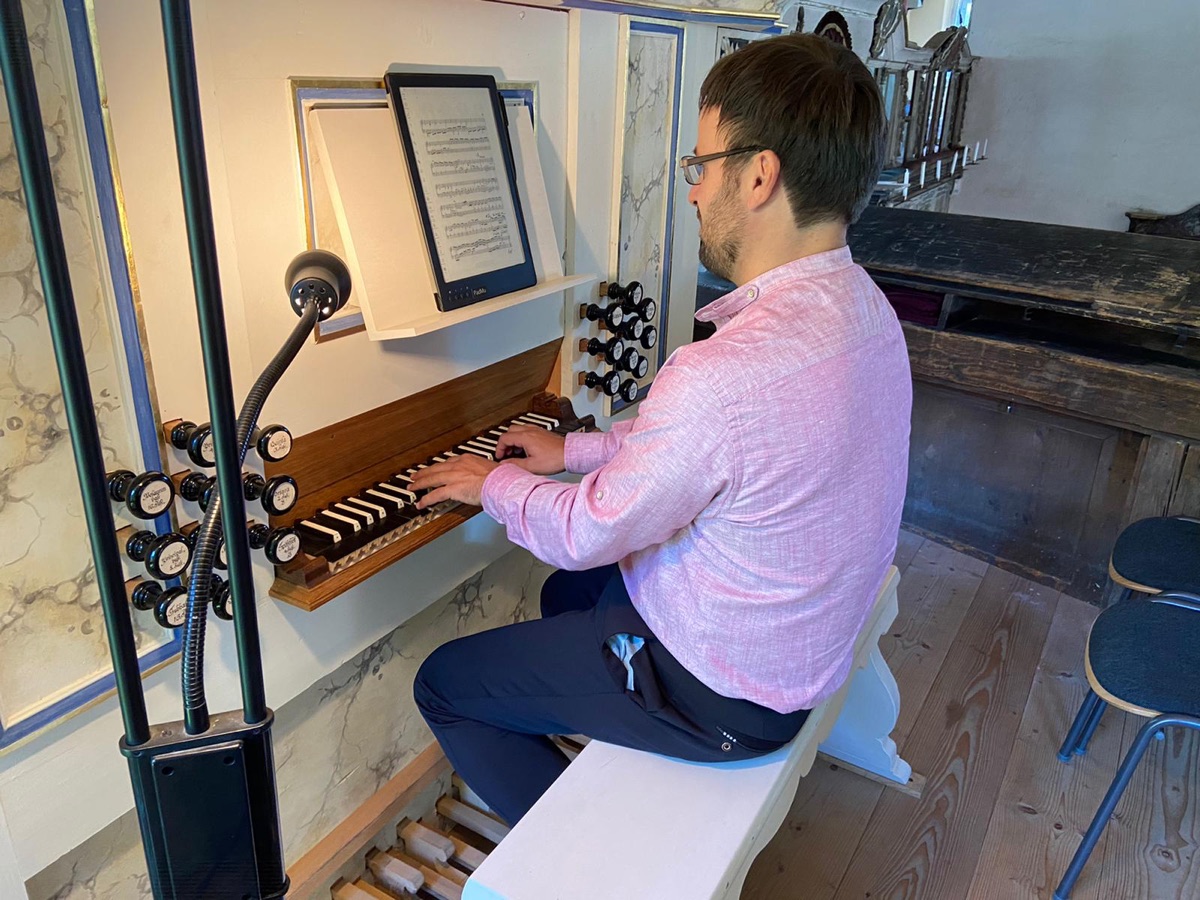
Listen: Organ in performance
A glimpse of Mirco Lieber performing Felix Mendelssohn's Organ Sonata No. 3, Op. 65, in A major, more of the repertoire (Bach, Buxtehude, Franck, Vierne, and others) lives on his concert site.
Why study organ with Mirco Lieber?
Mirco Lieber holds a MMag. from MDW University for Music and Performing Arts Vienna and the Academy of Music Ljubljana, with a specialisation in concert accordion, harpsichord, organ, and piano, and over 30 years of teaching experience.
Lessons cover manual and pedal coordination, stop registration, hymn accompaniment, and liturgical and concert repertoire. Whether you play for a Sunday service or are building toward the concert stage, lessons are shaped around your instrument and your goals.
What's included
- 1-on-1 live coaching via Zoom, tailored to your instrument and repertoire goals
- Pedal technique and manual-pedal coordination
- Registration and stop-combination guidance
- Hymn playing and liturgical accompaniment
- Session recordings and practice notes after every lesson
What makes the organ unique?
Unlike the piano or harpsichord, an organ produces sound through wind pushed across pipes (or, on digital instruments, simulated pipe ranks), there's no string or hammer at all. Each stop controls a different rank of pipes with its own timbre, and combining stops ("registration") is how organists build color and dynamics, since individual notes have no touch-dynamics of their own. Playing typically involves two or three manuals stacked above a full pedalboard played with the feet, so coordinating hands and feet independently is a core technique from day one.
For pianists, the transition is significant: legato is achieved through finger substitution and precise release timing rather than pedaling, and the pedal keyboard demands its own technique entirely separate from manual playing. Many students begin with manual-only repertoire and hymn accompaniment before adding pedal lines, building coordination gradually rather than all at once.
Topics covered
- Wind system and pipe mechanics, how tracker, electro-pneumatic, and digital actions differ
- Manual-pedal independence, building coordination from simple hymn lines to full repertoire
- Registration schemes, building historically appropriate and expressive stop combinations
- Legato technique, finger substitution and release timing (no sustain pedal)
- Service playing, hymn introductions, modulations, and liturgical timing
Frequently asked questions
Can I learn organ online?
Yes, Mirco Lieber, who holds a MMag. from MDW University Vienna and the Academy of Music Ljubljana, teaches organ entirely online through live 1-on-1 Zoom coaching. A webcam angled to show both hands and feet lets him watch manual fingering and pedal technique in real time, just as he would in person, and correct posture, registration choices, and pedal-foot placement as they happen. Lessons cover stop registration, independent pedalboard technique, hymn accompaniment, and liturgical and concert repertoire, with the curriculum adapted to your instrument, pipe, digital, or hybrid, and your current level, from complete beginner to advanced player preparing concert repertoire. Every session is recorded and followed up with written practice notes, so you can revisit exactly what was covered and keep working on technique between lessons rather than relying on memory alone.
Do I need a pipe organ to take lessons?
No. A full pipe organ is the ideal practice instrument, but the great majority of Mirco Lieber's students learn on something else entirely, a digital organ with sampled or modeled pipe ranks, a two-manual home instrument, or even a single-manual weighted keyboard paired with a separate MIDI pedalboard. What matters most for registration practice is a stop list you can experiment with, and for pedal technique, a full 32-note pedalboard rather than a shortened or non-standard one. If your current setup doesn't include a pedalboard yet, lessons can begin with manual-only repertoire and hymn accompaniment while you plan an upgrade. Mirco Lieber adapts registration suggestions, fingering, and pedal-technique guidance to whatever instrument you actually have access to, and will advise on affordable digital-organ or pedalboard options if you're deciding what to buy next.
Is this only for church organists?
No. Organ lessons with Mirco Lieber serve two overlapping but distinct groups equally well: church musicians who need to prepare hymns, liturgical accompaniment, and service playing with confidence, and students working toward concert repertoire such as Bach, Buxtehude, and the Romantic organ literature. Many students actually move between the two, a church organist building technique through concert repertoire, or a concert-track student who also plays occasional services. Because the curriculum is built around your goals rather than a fixed syllabus, lessons can focus entirely on hymn playing and liturgical timing, entirely on concert repertoire, or blend both as your needs change over time. Whether you're preparing for a Sunday service tomorrow or building toward a recital months from now, the technical foundations, registration, pedal technique, and manual coordination, are taught the same way and transfer directly between contexts.
What's the difference between organ and piano?
On piano, hammers strike the strings and the force of your touch directly shapes volume and tone, this touch-sensitivity is central to expressive playing. On organ, wind is pushed through pipes (or simulated digitally), and every note sounds at a fixed volume for whatever stop combination is selected; you can't get louder or softer by pressing harder. Expression instead comes from registration, choosing and combining stops, plus articulation and pacing. Organ also demands independent pedalboard technique, a separate keyboard played entirely with the feet while the hands do something different, which piano has no equivalent for. Manual (hand) technique transfers well between the two, since both use a similar keyboard layout, which is why pianists often adapt to organ manuals faster than complete beginners do. Repertoire differs too: organ centers on Bach, Buxtehude, and the Baroque and Romantic organ literature, plus liturgical accompaniment, while piano repertoire spans a far wider stylistic range.
Do I need to know how to play piano first?
No, but prior keyboard experience, piano, digital keyboard, or harpsichord, does give you a head start, since manual (hand) technique transfers well between instruments: the same finger patterns, scales, and hand independence you built at the piano carry over directly to the organ's manuals. What doesn't transfer is anything involving the feet, expression through touch, or registration, since the organ has no touch-dynamics and uses a completely separate pedal keyboard, so complete beginners aren't at a real disadvantage there. Pedal technique and stop registration are taught from the ground up regardless of your prior keyboard background, starting with basic foot positioning and simple hymn lines before building toward independent manual-pedal coordination. In practice, most students, whether experienced pianists or complete beginners, reach a comparable level of comfort with the pedalboard within the first several months of regular lessons.
Coming Soon: Self-Paced Organ Course, Level 1
1-on-1 coaching is available now (above). A self-paced Level 1 video course, in the same format as our piano courses, is currently in development. Planned curriculum:
- Wind system and pipe mechanics, how tracker, electro-pneumatic, and digital actions differ
- Manual-pedal independence, built up from the ground
- Registration schemes and appropriate stop combinations
- Legato technique via finger substitution, no sustain pedal
- Service playing: hymn introductions and liturgical timing
What our students say
★★★★★
"The lessons with Mirco are exactly what I was looking for. We aligned the content and learning goals together right from the start and made quick progress. The lesson pace is just right, and follow-up questions are answered competently. The technique really works. I can highly recommend Mirco as a piano teacher!" — Andi H., Google Review
★★★★★
"Mirco is a very good and dedicated piano teacher. The lessons are a lot of fun and always clearly structured. You can tell he genuinely cares about my progress." — Antje L., Google Review
★★★★★
"My daughter always enjoys her lessons with Mirco very much. We're very glad our paths crossed and that we found such wonderful lessons, unbound by any particular location." — Kathrin, Google Review
Ready to start?
Book a free 15-minute discovery call, no commitment, no pressure.
Book Your Discovery Call →