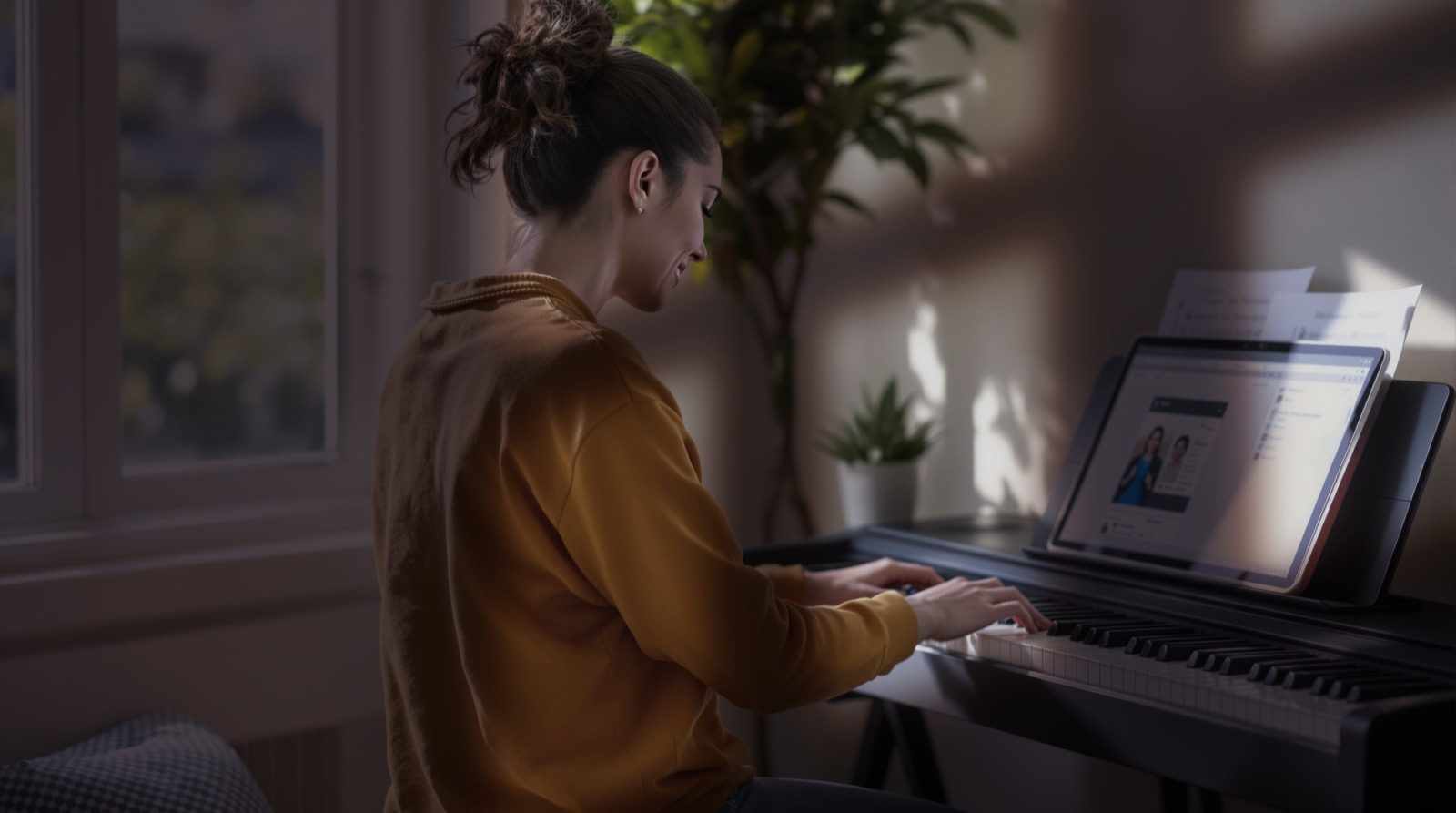
"How long until I can play the piano?", this is the question I get in almost every first lesson. The honest answer separates three things that people too often lump together: your first song, secure playing, and concert-level virtuosity. Once you keep those levels apart, you understand why "a few weeks," "a year," and "a decade" can each be the right answer, depending on the question.
Three Honest Timelines
- Your first song: With good guidance and 15 to 20 minutes of daily practice, most absolute beginners can play a simple two-hand song cleanly within 4 to 8 weeks.
- Secure repertoire: A connected, fluently playable basic repertoire typically emerges after 9 to 12 months of structured lessons, provided the technique is built correctly from the start.
- Concert-level classical works: If you want to play Chopin etudes or serious Bach fugues, plan realistically for several years. That's not discouragement, that's perspective: the same timelines apply to violin, guitar, or any other serious instrument.
What Actually Drives Progress
The clock doesn't run on practice hours; it runs on regularity and the quality of practice. Less important than the headcount is the answer to three questions: Do you practice daily in short sessions instead of rarely in marathons? Do you get feedback while you're still making mistakes, rather than cementing them for weeks? And does your path build in small, achievable steps, so you experience success instead of clinging to overwhelm?
The most common cause of long plateaus is not a lack of talent but badly built technique: careless fingering, a tense posture, or a repertoire that's always a little too hard. This is exactly where the difference between an experienced teacher and a learning app shows: a teacher corrects in real time what no video will show you.
Adults Don't Take Longer, They Learn Differently
Adults don't learn slower than children; they learn differently: they understand theory faster, plan better, and are more patient, while often having less practice time and higher expectations of themselves. The realistic approach in adulthood is to tie your practice to your daily routine and schedule ten minutes a day rather than two hours on the weekend. Do that, and you'll reach a solid basic repertoire in about the same time as a motivated teenager.
The most common pitfalls on this path are covered in our article Can Adults Learn Piano?, including why adults are often faster than children.
Why a Teacher Makes the Difference
A good teacher doesn't shorten the path through shortcuts but through more efficient steps: correct technique from hour one, suitable repertoire, a realistic pace, and honest feedback on when you're ready for the next step. That prevents the typical plateaus that self-learners only notice after months. A free trial lesson gives you exactly that feedback to try once, no commitment.
Frequently Asked Questions
How long does it take to learn piano as a beginner?
Simple songs become playable within a few weeks with regular practice of about 15 to 20 minutes a day. A first solid, fluent repertoire typically emerges after 9 to 12 months of structured lessons. Concert-level classical works take several years, that's true for every instrument.
How many minutes a day should I practice piano?
For adult beginners, 15 to 20 minutes daily, six days a week, is entirely enough to make real progress in the first year. Short daily sessions beat irregular marathons because your brain consolidates between practice sessions.
Can you learn piano in three months?
In three months of guided study most people can play their first real two-hand songs and read basic notation. What doesn't develop in that time is fluent, secure playing, that takes about a year. If you hear fast promises, be skeptical.
When can you play your first classical piece?
Easy classical pieces (such as simple Bach inventions or opening pieces from method books) are reachable after 1 to 2 years if technique is built cleanly. Heavy concert literature needs several years and a high practice load. The faster route goes through a teacher who builds you properly rather than rushing you ahead.
Get an Honest Assessment, Free
Find out in a free lesson how fast you can realistically progress, with an honest timeline estimate from lesson one.
Book a Free Lesson →