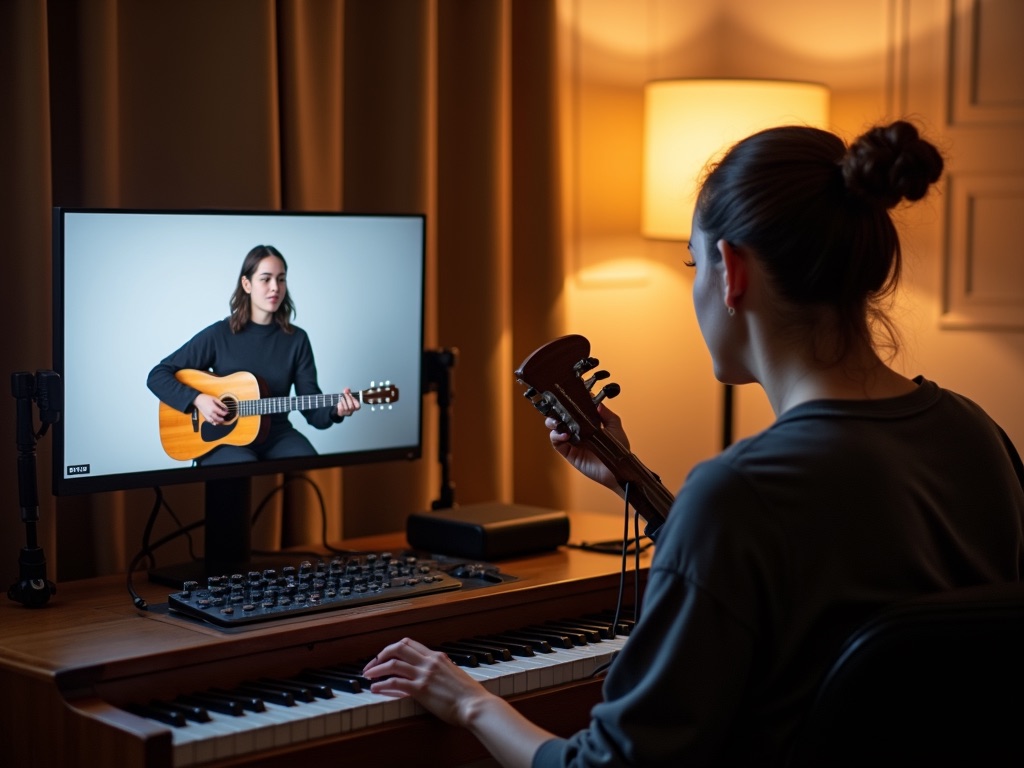
Choosing online piano lessons as an adult is mostly a question of fit, not of finding one best provider. Adults bring a busy schedule, a clear idea of the music they want to play and little patience for material made for children. This guide lists the criteria worth checking, explains who each format suits and names the mistakes I see most often.
After 30+ years of teaching, I would rather give you criteria to compare than a ranking that is out of date within months. For every provider, check the current offer on their own website. Towards the end I describe my own offer as one option among several.
Checklist: What to Look for in Online Piano Lessons
1. Live feedback or self-paced?
Ask who looks at how you play. In live lessons a teacher sees and hears you and can correct hand position, posture and tension straight away. Self-paced formats such as apps and video courses let you practise whenever you like, but feedback is limited to what the software can detect or what you notice yourself. Neither is wrong; decide which kind of feedback you need.
2. Teacher qualifications
Look for formal training in music (a degree in performance or music education) and experience of teaching adults. Ask where and what the teacher studied and which instruments they teach; a serious teacher answers openly. Teaching adults needs different pacing and explanations than teaching children.
3. A trial lesson
A trial lesson shows whether the teaching style and the technical setup suit you before you commit. Check whether it is free, how long it is and whether it is a real lesson or mainly a sales call.
4. Price model
Providers charge by subscription, per lesson or per package with a fixed term. Compare the total cost over the whole period, not only the monthly figure, and check what is included (live time, materials, recordings) and whether extra fees apply. Prices differ between providers and change over time, so check each provider's current pricing.
5. Contract and cancellation terms
Read how long you are bound, whether the contract renews automatically, how cancellation works and what happens to lessons you cannot attend. A fixed term without automatic renewal is easier to judge than an open-ended subscription.
6. Level and repertoire fit
Say what you want to play: classical, jazz, pop, film music or folk. A good teacher builds exercises around that music, while a fixed curriculum is the same for everyone. Check that the offer matches your level, from absolute beginner to returning player.
7. Time zone and language
Live lessons need times that suit both sides. Check the teacher's time zone, the lesson languages and how rescheduling works.
8. Equipment basics
You need a piano or keyboard (a digital piano with weighted keys is ideal, but a smaller keyboard is enough to start), a device with a camera and microphone, a stable internet connection and a place to practise. For live lessons, the teacher should show you how to place the camera so that your hands and posture are visible.
Apps and live lessons: how they differ
Popular apps such as flowkey, Simply Piano or Skoove are well made and strong at what they are built for: structured note-reading and rhythm practice, playing along to songs, a low entry cost and practising at any time of day. They are a good way to start or to keep up a daily habit.
A live teacher adds what an app cannot see: real-time feedback on hand position, posture and tension, repertoire chosen around your taste, explanations of why something works and accountability through a regular appointment. Many adults use both, an app or video course for daily repetition and live lessons for technique and musicality. For a closer look, see the app vs. teacher comparison.
Which format suits whom?
- Live 1-to-1 lessons suit you if you want feedback on your technique, music you choose yourself and a regular appointment that keeps you practising.
- Apps suit you if you want to explore at low cost, learn at irregular times or train note-reading between lessons.
- Self-paced video courses suit you if you like to follow a structured plan on your own and are fine without personal feedback.
- A marketplace suits you if you want to compare many independent teachers; check each profile and use a trial lesson.
- A combination (app or course plus live lessons) often works well for adults who want both flexibility and feedback.
Common mistakes
- Choosing by price alone. A low monthly price does not help if you stop using the offer.
- Skipping the trial lesson or not asking about qualifications.
- Not reading the contract: automatic renewal, notice periods and extra fees surprise people later.
- Expecting an app to correct technique it cannot see, or a video course to answer individual questions.
- Waiting for the perfect provider instead of starting with a trial lesson and adjusting later.
- Practising without a plan. Whatever you choose, regular short sessions usually work better than rare long ones.
Mirco Lieber's offer as one option
If live lessons fit your criteria, my own offer is one option to compare: live 1-to-1 on Zoom, online only, for adults from absolute beginners to returning players, in all genres, in English, German, Slovenian or Portuguese. These are the current prices at ML Elite Online Music School. All prices include 16% VAT; the first 30-minute trial lesson is free.
| Option | Price | Term |
|---|---|---|
| Trial lesson, 30 minutes | Free | Single lesson, no obligation |
| Single lesson, 30 minutes | €32 | Single lesson, no subscription |
| Single lesson, 45 minutes | €42 | Single lesson, no subscription |
| ML-Economic | €145 per month (€580 in total, or €522 if paid in full; about USD 168 per month) | 4 months, fixed term |
| ML-Serious | €189 per month | 6 months, fixed term |
| ML-Ambitious | €229 per month | 6 months, fixed term |
Coaching packages have a one-time €5 joining fee and a fixed term without automatic renewal. The binding terms are in the terms and conditions (AGB).
Start With a Free Trial Lesson
Book a free 30-minute trial lesson with Mirco Lieber, or try the free starter material first. No card needed.
Start Free →