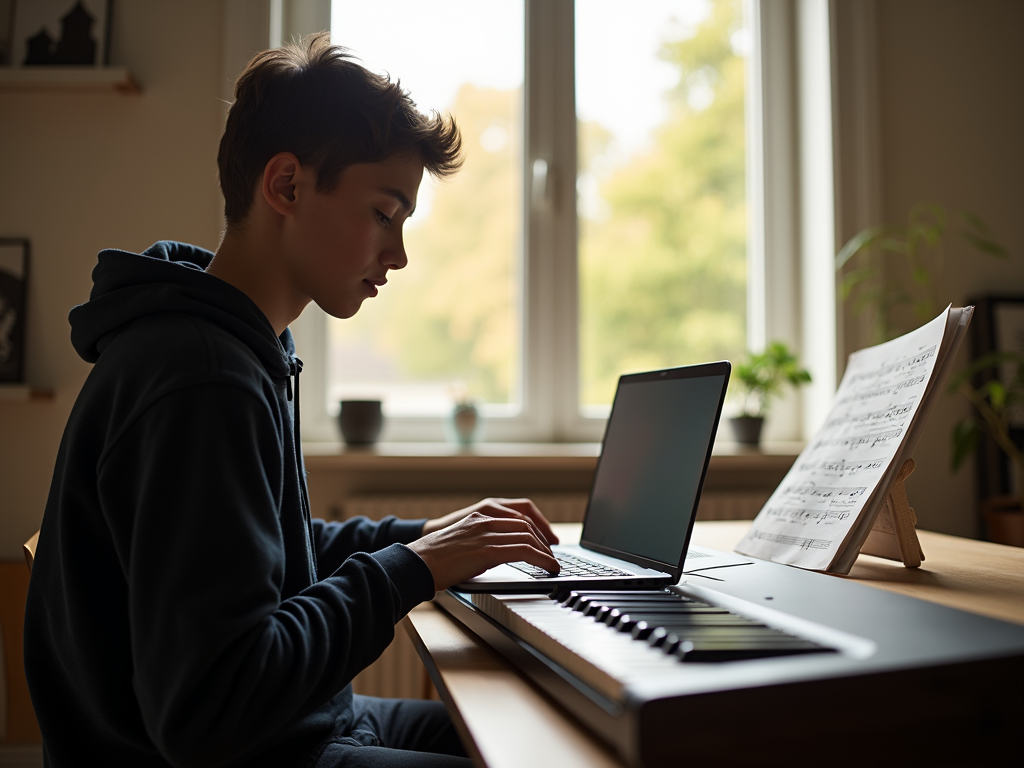
Can an adult learn piano? Short answer: yes — and often faster than a child. In 30+ years of teaching, I've watched students in their 40s, 50s, and 60s go from zero experience to playing complete pieces within weeks. The difference between those who succeed and those who quit has nothing to do with age or talent. It comes down to structure, expectations, and having the right feedback loop.
Why Adults Actually Have an Advantage
Most people assume children learn piano faster because their brains are more plastic. That's true for some motor skills, but adults bring three advantages children don't have:
- Self-directed practice. An adult can decide to work on a specific problem for 15 minutes without needing a parent to supervise. That focused attention compounds quickly.
- Conceptual understanding. Adults understand music theory as a system — intervals, chord functions, key relationships — rather than memorising isolated facts. This makes longer-term progress faster.
- Clear motivation. You're not learning because a parent signed you up. You chose this. That intrinsic drive sustains practice through the frustrating weeks.
About 40% of my private students start with zero prior musical experience. The oldest beginner I've taught was 72. Within three months, she was playing simplified arrangements of Debussy.
How Long Does It Really Take?
Here's a realistic timeline based on 20 minutes of daily practice:
- Day 1: You play your first correct note and understand the keyboard layout.
- Week 1: A simple one-hand melody, clean and in time.
- Week 3-4: Basic chords (C, F, G major) and simple left-hand patterns.
- Week 5-6: Both hands together — the breakthrough moment where piano starts feeling like piano.
- Week 8: One complete song, melody and accompaniment, start to finish.
- Month 6: Playing multiple pieces confidently, reading simple notation, understanding basic music theory.
- Year 1: Intermediate repertoire, scales in several keys, sight-reading ability, and the skill to learn new pieces independently.
This isn't a best-case scenario. These are typical results for adults who practise consistently and have structured guidance. Without structure — jumping between YouTube tutorials, using only an app, no clear plan — most adults stall at week 3 and quit by week 6.
What Actually Makes Adults Quit
It's not lack of talent. It's three specific traps:
- No feedback loop. Apps tell you whether you hit the right note. They can't tell you why your wrist is tense, why a phrase sounds stiff, or why your left hand is rushing. Without correction, small faults become habits that block progress.
- Unrealistic expectations. A 40-year-old who expects to play Chopin after three months will quit in frustration. A 40-year-old who aims for one clean song in eight weeks is more likely to keep going and surpass that goal.
- Inconsistent practice. Two hours on Saturday then nothing until Wednesday builds almost no muscle memory. Fifteen minutes every day builds real, visible progress.
What Does Quality Adult Piano Teaching Look Like?
After three decades of teaching, I've found that adult beginners need three things that most self-taught methods don't provide:
1. Real-time technique correction
Your hand position, finger curvature, and wrist relaxation determine whether you plateau after six weeks or keep improving for years. A live teacher sees these in the first session. An app never will.
2. A structured path with achievable milestones
"Learn piano" is too vague. "Play this specific 8-bar melody with both hands by Friday" is a target you can hit. Good teaching breaks the vast skill of piano into weekly chunks that feel manageable.
3. Repertoire you actually want to play
Adults learn fastest when they're playing music they love. A good teacher adapts the curriculum to your taste — pop, classical, jazz, film scores — rather than forcing every student through the same etudes.
The Cost Question: App vs. Teacher vs. Course
Let's be specific about what different approaches actually cost:
- Piano apps (Simply Piano, flowkey, Skoove): €110-200 per year subscription. Good for daily note-reading practice. Cannot correct technique.
- Self-paced video course (like ML Elite Level 1): €63 one-time, lifetime access. Structured curriculum, teacher-led demonstrations, printable materials. No real-time correction.
- 1-on-1 coaching (live weekly lessons): €580+ for 12 weeks. Full feedback loop, personalised pacing, session recordings. Fastest progress.
- In-person local teacher: Varies widely (€30-80 per hour). Best for those who can commute regularly.
Many adult students combine a structured self-paced course for daily work with occasional live coaching for technique checks. That hybrid approach delivers the fastest return per euro spent.
But Am I Too Old?
No. This is the single most common question I hear, and the answer never changes. There is no age at which the brain loses the ability to learn a new motor skill. What changes is how quickly fine motor coordination settles in — a 25-year-old might develop finger independence slightly faster than a 60-year-old — but the difference is measured in weeks, not years. Every adult student I've taught has reached a satisfying level of playing within a structured 90-day plan regardless of starting age.
The real question isn't "am I too old?" It's "do I have 15 minutes a day and a clear plan?" If the answer to that is yes, you will learn piano at any age.
Ready to Start? Try It Free
The free 5-day piano starter course is Day 1 of the 90-day plan. No card needed, no commitment. See for yourself whether this approach works for you.
Start Free →Frequently Asked Questions
Can I learn piano if I have no musical background?
Yes — that is the normal starting point for most adult students. A good structured plan assumes zero prior knowledge and builds every concept from first principles.
How much should I practice each day?
15-20 focused minutes daily beats 2 hours once a week. Consistency builds the muscle memory that makes progress feel real.
Do I need to read sheet music to start?
No. Most adult beginners start with simplified notation or chord charts and pick up standard notation gradually alongside real playing.
Can I really learn without someone watching my hands?
Live video lessons let a teacher see hand position, posture, and finger technique in real time. Camera angle matters, but correction works essentially the same as in person.
What if I already tried an app and quit?
Most people who quit an app didn't lack discipline — they lacked a feedback loop. A live teacher can usually spot and fix the specific fault that stalled your progress within the first session. That alone changes the experience completely.